b_Regression_Analysis
Download script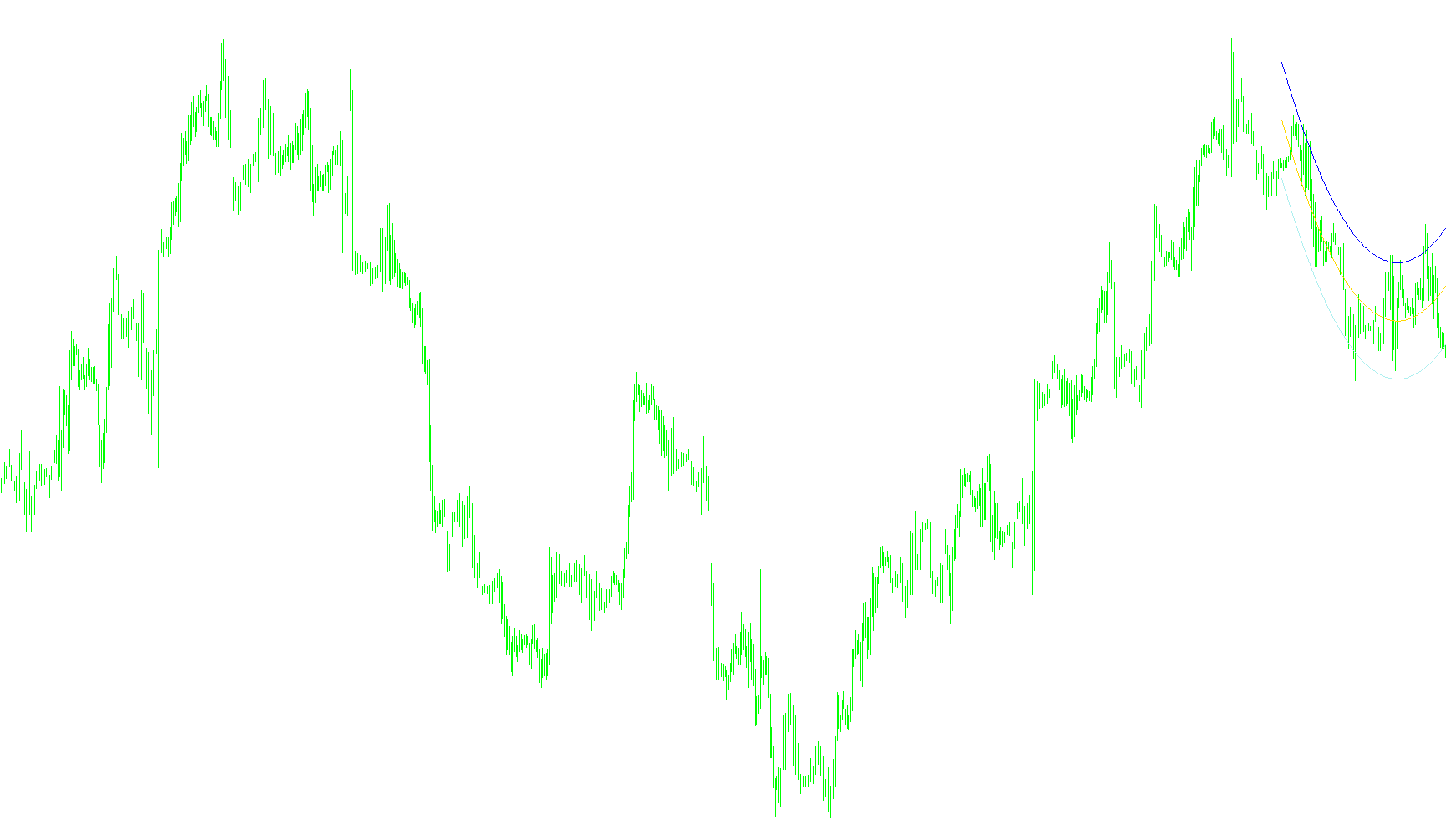
Overview of the Regression Analysis Tool
This script is designed to analyze price trends by mathematically fitting different types of curves to historical market data. Instead of just showing a simple moving average, it attempts to find the "best-fit" mathematical model to describe how the current price is moving over a specific period.
How the Logic Works
The tool operates through a multi-step evaluation process to determine which mathematical model most accurately represents the current market behavior:
1. Multi-Model Testing The script simultaneously calculates four different types of regression models based on your chosen data points (the "dp_limiter"):
- Linear Regression: Fits a straight line to the data.
- Quadratic Regression: Fits a parabolic curve (useful for identifying rounded bottoms or tops).
- Logarithmic Regression: Fits a curve that changes rapidly and then flattens out.
- Exponential Regression: Fits a curve that grows or decays at an accelerating rate.
2. Accuracy Scoring (Error Analysis) For every model calculated, the script measures the "Standard Deviation of Error." In simple terms, it looks at the gap between the actual price and the line created by each mathematical model. The smaller the gap (the lower the error), the more "accurate" that specific model is for the current market conditions.
3. Automatic Selection (The "Best Fit") The script automatically compares the accuracy scores of all four models. It identifies which model has the lowest error and selects it as the primary trend line. This allows the indicator to be dynamic; for example, it might switch from a linear line during a steady trend to a quadratic curve during a volatile price cycle.
4. Confidence Bands Once the best-fitting line is chosen, the script calculates "Confidence Bands." These are visual boundaries (upper and lower) placed above and below the main trend line. They are based on the volatility of the data:
- When the market is stable, the bands stay close to the center line.
- When the market is volatile, the bands widen to reflect the increased uncertainty.
Data Recording
The script includes an optional logging feature. If enabled, it will create a text file on your computer and record the error scores for all four models at specific time intervals. This allows you to review how the "accuracy" of different mathematical models changed over a long period of time.
Summary for the User
In short, this tool tells you: "Based on the last X amount of price data, here is the most mathematically accurate curve representing our current trend." It automatically swaps between different shapes (lines vs. curves) to ensure it is always showing you the most relevant trend possible for the current market state.
//+--------------------------------------------------------------------------------------------------+
//|                                                                        b_Regression_Analysis.mq4 |
//|                                                                    Copyright © 2011, barmenteros |
//|                                                            http://www.mql4.com/users/barmenteros |
//+--------------------------------------------------------------------------------------------------+
#property copyright "barmenteros"
#property link      "barmenteros.fx@gmail.com"

#property indicator_chart_window
#property indicator_buffers 3
#property indicator_color1 Magenta
#property indicator_color2 Blue
#property indicator_color3 Blue

// ---- inputs
// dp_limiter  It should be >2 . If not it will be autoset to default value
// endpos      Last value position to the right. It should be >0. If not it will be autoset to
//             default value
// record      [true] - record on; [false] - record off
extern int       dp_limiter   =100;             // Number of data points
extern int       endpos       =0;               // Last value position
extern double    multStdDev   =1.96;            // Bands separation
extern bool      record       =false;           // Record info into a file text

// ---- buffers
double RegBfr[];
double BandUpBfr[];
double BandDwBfr[];
double AuxRegBfr[];

// ---- global variables
int      pos,
         c_handle,p_handle,
         current_day,previous_day,
         datapoints;
double   sumxvalues[1],
         sumyxvalues[1],
         matrix[1][10],
         constant[1],
         errorstddev[4];

//+--------------------------------------------------------------------------------------------------+
//| Custom indicator initialization function                                                         |
//+--------------------------------------------------------------------------------------------------+
int init()
  {
   // ---- 1 additional buffer
   IndicatorBuffers(4);

   // ---- checking inputs
   if(dp_limiter<3)
      {
       dp_limiter=100;
       Alert("dp_limiter readjusted");
      }
   if(endpos<0)
      {
       endpos=0;
       Alert("endpos readjusted");
      }

   // ---- drawing settings
   SetIndexStyle(0,DRAW_LINE);
   SetIndexStyle(1,DRAW_LINE);
   SetIndexLabel(1,"UpperBand");
   SetIndexStyle(2,DRAW_LINE);
   SetIndexLabel(2,"LowerBand");

   // ---- mapping
   SetIndexBuffer(0,RegBfr);
   SetIndexBuffer(1,BandUpBfr);
   SetIndexBuffer(2,BandDwBfr);
   SetIndexBuffer(3,AuxRegBfr);

   // ---- done
   return(0);
  }

//+--------------------------------------------------------------------------------------------------+
//| Custom indicator iteration function                                                              |
//+--------------------------------------------------------------------------------------------------+
int start()
  {
   if(record)
      {
       previous_day=current_day;
       current_day=TimeDay(TimeCurrent());
       if(current_day!=previous_day)
         {
          p_handle=c_handle;
          c_handle=FileOpen(StringConcatenate(TimeYear(TimeCurrent()),"-",TimeMonth(TimeCurrent()),"-",current_day,"-",Symbol(),"-b_Regression_Analysis.txt"),FILE_CSV|FILE_READ|FILE_WRITE);
          if(c_handle>0 && c_handle!=p_handle)
            {
             if(p_handle>0)
               FileClose(p_handle);
             FileWrite(c_handle,"time","error[LinReg]","error[QuadReg]","error[LogReg]","error[ExpReg]");
            }
         }
      }

   datapoints=dp_limiter;
   pos=endpos+datapoints-1;
   PolynomialRegression(1);
   errorstddev[0]=StdDevRegError();
   PolynomialRegression(2);
   errorstddev[1]=StdDevRegError();
   LogarithmicRegression();
   errorstddev[2]=StdDevRegError();
   ExponentialRegression();
   errorstddev[3]=StdDevRegError();

   if(record)
      if(c_handle>0)
         FileWrite(c_handle,StringConcatenate(TimeHour(TimeCurrent()),":",TimeMinute(TimeCurrent()),":",TimeSeconds(TimeCurrent())),errorstddev[0],errorstddev[1],errorstddev[2],errorstddev[3]);

   BestReg();
   ConfidenceBands();

   // ----
   return(0);
  }

//+--------------------------------------------------------------------------------------------------+
//| Custom indicator deinitialization function                                                       |
//+--------------------------------------------------------------------------------------------------+
int deinit()
  {
   Comment("");
   if(c_handle>0)
      FileClose(c_handle);

   //----
   return(0);
  }

void PolynomialRegression(int grade)
   {
    // y=c0+c1x+c2x^2+c3x^3...cnx^n
    // grade+1    número de funciones y de coeficientes a calcular
    // 2*grade    valor del mayor exponente
    // datapoints número de valores a considerar
    // pos        first value position (left to right direction)
    int     exp,k,row,col,
            initialrow,initialcol,
            loop,i,j;
    double  sumx,sumyx,sum;

    ArrayResize(sumxvalues,2*grade+1);
    ArrayResize(sumyxvalues,grade+1);
    ArrayInitialize(sumxvalues,0.0);
    ArrayInitialize(sumyxvalues,0.0);
    sumxvalues[0]=datapoints;
    for(exp=1;exp<=2*grade;exp++)
      {
       sumx=0.0;
       sumyx=0.0;
       for(k=1;k<=datapoints;k++)
         {
          sumx+=MathPow(k,exp);
          if(exp==1)
            sumyx+=Close[pos-k+1];
          else if(exp<=grade+1)
            sumyx+=Close[pos-k+1]*MathPow(k,exp-1);
         }
       sumxvalues[exp]=sumx;
       if(sumyx!=0.0)
         sumyxvalues[exp-1]=sumyx;
      }
    ArrayResize(matrix,grade+1);
    ArrayInitialize(matrix,0.0);
    for(row=0;row<=grade;row++)
      for(col=0;col<=grade;col++)
         matrix[row][col]=sumxvalues[row+col];
    initialrow=1;
    initialcol=1;
    for(loop=1;loop<=grade;loop++)
      {
       for(row=initialrow;row<=grade;row++)
         {
          sumyxvalues[row]=sumyxvalues[row]-(matrix[row][loop-1]/matrix[loop-1][loop-1])*sumyxvalues[loop-1];
          for(col=initialcol;col<=grade;col++)
            matrix[row][col]=matrix[row][col]-(matrix[row][loop-1]/matrix[loop-1][loop-1])*matrix[loop-1][col];
         }
       initialrow++;
       initialcol++;
      }
    ArrayResize(constant,grade+1);
    ArrayInitialize(constant,0.0);
    j=0;
    for(i=grade;i>=0;i--)
      {
       if(j==0)
          constant[i]=sumyxvalues[i]/matrix[i][i];
       else
         {
          sum=0.0;
          for(k=j;k>0;k--)
            sum+=constant[i+k]*matrix[i][i+k];
          constant[i]=(sumyxvalues[i]-sum)/matrix[i][i];
         }
       j++;
      }
    ArrayInitialize(AuxRegBfr,EMPTY_VALUE);
    k=1;
    for(i=datapoints-1;i>=0;i--)
      {
       sum=0.0;
       for(j=0;j<=grade;j++)
         sum+=constant[j]*MathPow(k,j);
       AuxRegBfr[i+endpos]=sum;
       k++;
      }
   }

void LogarithmicRegression()
   {
    // y=c0*x^c1
    // lny=lnc0+c1lnx <=> y=a+bx
    // c0=e^a
    // c1=b
    int     exp,k,row,col,
            initialrow,initialcol,
            loop,i,j;
    double  sumx,sumyx,lnx,a;

    ArrayResize(sumxvalues,3);
    ArrayResize(sumyxvalues,2);
    ArrayInitialize(sumxvalues,0.0);
    ArrayInitialize(sumyxvalues,0.0);
    sumxvalues[0]=datapoints;
    for(exp=1;exp<=2;exp++)
      {
       sumx=0.0;
       sumyx=0.0;
       for(k=1;k<=datapoints;k++)
         {
          lnx=MathLog(k);
          sumx+=MathPow(lnx,exp);
          if(exp==1)
            sumyx+=MathLog(Close[pos-k+1]);
          else
            sumyx+=MathLog(Close[pos-k+1])*MathPow(lnx,exp-1);
         }
       sumxvalues[exp]=sumx;
       if(sumyx!=0.0)
         sumyxvalues[exp-1]=sumyx;
      }
    ArrayResize(matrix,2);
    ArrayInitialize(matrix,0.0);
    for(row=0;row<=1;row++)
      for(col=0;col<=1;col++)
         matrix[row][col]=sumxvalues[row+col];
    sumyxvalues[1]=sumyxvalues[1]-(matrix[1][0]/matrix[0][0])*sumyxvalues[0];
    matrix[1][1]=matrix[1][1]-(matrix[1][0]/matrix[0][0])*matrix[0][1];
    ArrayResize(constant,2);
    ArrayInitialize(constant,0.0);
    constant[1]=sumyxvalues[1]/matrix[1][1];
    a=(sumyxvalues[0]-(constant[1]*matrix[0][1]))/matrix[0][0];
    constant[0]=MathExp(a);
    ArrayInitialize(AuxRegBfr,EMPTY_VALUE);
    k=1;
    for(i=datapoints-1;i>=0;i--)
      {
       AuxRegBfr[i+endpos]=constant[0]*MathPow(k,constant[1]);
       k++;
      }
   }

void ExponentialRegression()
   {
    // y=c0*e^(xc1)
    // lny=lnc0+c1x <=> y=a+bx
    // c0=e^a
    // c1=b
    int     exp,k,row,col,
            initialrow,initialcol,
            loop,i,j;
    double  sumx,sumyx,a;

    ArrayResize(sumxvalues,3);
    ArrayResize(sumyxvalues,2);
    ArrayInitialize(sumxvalues,0.0);
    ArrayInitialize(sumyxvalues,0.0);
    sumxvalues[0]=datapoints;
    for(exp=1;exp<=2;exp++)
      {
       sumx=0.0;
       sumyx=0.0;
       for(k=1;k<=datapoints;k++)
         {
          sumx+=MathPow(k,exp);
          if(exp==1)
            sumyx+=MathLog(Close[pos-k+1]);
          else
            sumyx+=MathLog(Close[pos-k+1])*MathPow(k,exp-1);
         }
       sumxvalues[exp]=sumx;
       if(sumyx!=0.0)
         sumyxvalues[exp-1]=sumyx;
      }
    ArrayResize(matrix,2);
    ArrayInitialize(matrix,0.0);
    for(row=0;row<=1;row++)
      for(col=0;col<=1;col++)
         matrix[row][col]=sumxvalues[row+col];
    sumyxvalues[1]=sumyxvalues[1]-(matrix[1][0]/matrix[0][0])*sumyxvalues[0];
    matrix[1][1]=matrix[1][1]-(matrix[1][0]/matrix[0][0])*matrix[0][1];
    ArrayResize(constant,2);
    ArrayInitialize(constant,0.0);
    constant[1]=sumyxvalues[1]/matrix[1][1];
    a=(sumyxvalues[0]-(constant[1]*matrix[0][1]))/matrix[0][0];
    constant[0]=MathExp(a);
    ArrayInitialize(AuxRegBfr,EMPTY_VALUE);
    k=1;
    for(i=datapoints-1;i>=0;i--)
      {
       AuxRegBfr[i+endpos]=constant[0]*MathExp(k*constant[1]);
       k++;
      }
   }

void BestReg()
   {
    string  short_name;
    double  currentstddev;
    int     c_stddevindex,i;

    Comment("LinReg=",errorstddev[0]," || QuadReg=",errorstddev[1]," || LogReg=",errorstddev[2]," || ExpReg=",errorstddev[3]);
    currentstddev=errorstddev[0];
    c_stddevindex=0;
    for(i=1;i<=3;i++)
      {
       if(errorstddev[i]<currentstddev)
         {
          currentstddev=errorstddev[i];
          c_stddevindex=i;
         }
      }
    switch(c_stddevindex)
      {
       case 0 : PolynomialRegression(1); short_name="LinReg";  break;
       case 1 : PolynomialRegression(2); short_name="QuadReg"; break;
       case 2 : LogarithmicRegression(); short_name="LogReg";  break;
       case 3 : ExponentialRegression(); short_name="ExpReg";  break;
       default :PolynomialRegression(1); short_name="LinReg";
      }
    SetIndexLabel(0,short_name);
    IndicatorShortName(short_name+"("+datapoints+")");
    ArrayInitialize(RegBfr,EMPTY_VALUE);
    for(i=datapoints-1;i>=0;i--)
      RegBfr[i+endpos]=AuxRegBfr[i+endpos];
   }

double StdDevRegError()
   {
    int     i;
    double  sum,arithmean,stddev;

    sum=0.0;
    for(i=datapoints-1;i>=0;i--)
      sum+=MathAbs(Close[i+endpos]-AuxRegBfr[i+endpos]);
    if(datapoints<=0) datapoints=1;
    arithmean=sum/datapoints;
    sum=0.0;
    for(i=datapoints-1;i>=0;i--)
      sum+=(Close[i+endpos]-AuxRegBfr[i+endpos]-arithmean)*(Close[i+endpos]-AuxRegBfr[i+endpos]-arithmean);
    if(datapoints<=0) datapoints=1;
    stddev=MathSqrt(sum/datapoints);
    return(stddev);
   }

void ConfidenceBands()
   {
    int     i;
    double  sum,variance;

    sum=0.0;
    for(i=datapoints-1;i>=0;i--)
      sum+=(Close[i+endpos]-RegBfr[i+endpos])*(Close[i+endpos]-RegBfr[i+endpos]);
    variance=MathSqrt(sum/datapoints);
    ArrayInitialize(BandUpBfr,EMPTY_VALUE);
    ArrayInitialize(BandDwBfr,EMPTY_VALUE);
    for(i=datapoints-1;i>=0;i--)
      {
       BandUpBfr[i+endpos]=RegBfr[i+endpos]+(multStdDev*variance);
       BandDwBfr[i+endpos]=RegBfr[i+endpos]-(multStdDev*variance);
      }
   }
Comments