Extrapolator
Download script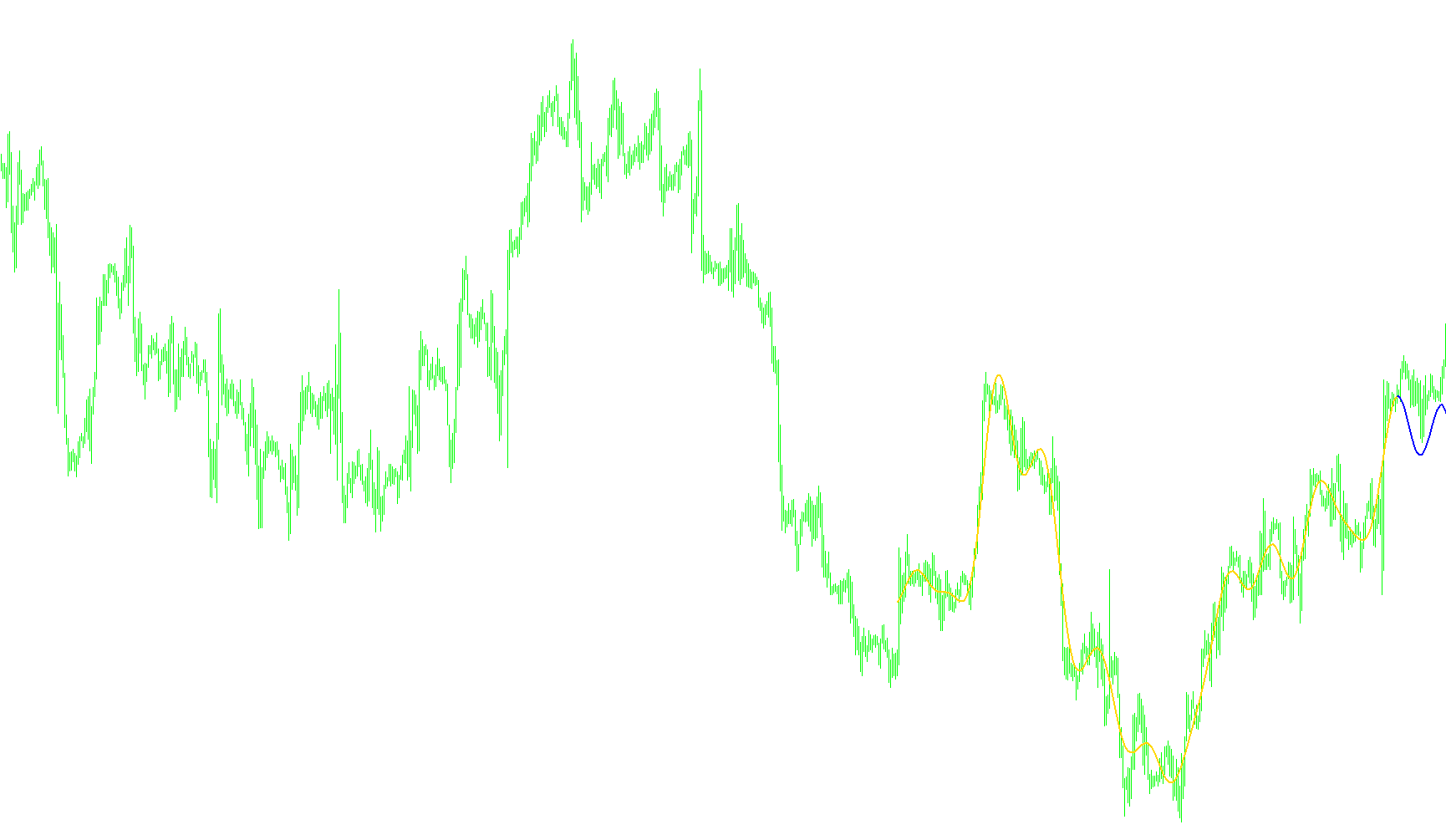
This script is designed as a mathematical forecasting tool for trading charts. Its primary purpose is to analyze historical price data and "extrapolate"—or project—potential future price movements based on identified patterns. It works by looking at a specific block of past prices and using different mathematical models to guess where the price might go next.
Here is a breakdown of how the logic functions for a non-technical user:
Core Concept
The tool looks at a window of history (which you can define, such as the last 300 bars) and attempts to find a "rule" that explains those past movements. Once it identifies that rule, it extends that rule into the future to create a projected line on your chart.
The Different Prediction Methods
The script offers several different mathematical "engines" to choose from, depending on what kind of pattern you believe the market is following:
- Trigonometric Series (Method 1): This method assumes the market moves in repeating waves or cycles (like a sine wave). It looks for recurring frequencies in the data and tries to project the next "wave" of price action.
- Linear Prediction Models (Methods 2 through 6): These methods are more advanced statistical techniques used to predict a sequence of numbers based on their previous values. They include:
- ACF (Autoregressive): Looks for correlations between current prices and past prices at specific intervals.
- Burg & HNBurg Methods: Advanced algorithms often used in signal processing to predict future points while minimizing "noise" or errors in the data.
- Geometric Method: Analyzes the mathematical relationship between data points to find a trend shape.
- Covariance Method: A sophisticated approach that attempts to solve for the most likely next step by calculating how much different variables in the price history vary together.
How the Calculation Works
Regardless of which method is chosen, the script follows a consistent logical flow:
- Data Collection: It gathers the "Open" prices from the timeframe you specified in the settings.
- Average Baseline: It calculates an average price to establish a starting point for its calculations.
- Pattern Matching: Based on your chosen method, it runs the math (the "engines" mentioned above) to find the coefficients—essentially the "DNA"—of the current price movement.
- Projection: It takes those coefficients and applies them to the empty space ahead of the current price.
- Visualization: It draws two lines on your chart: one representing the historical data it used for the calculation and another representing the predicted future path.
Key Parameters Explained
- LastBar / PastBars: Defines how much history the script "reads" to learn the pattern.
- FutBars: Defines how far into the future the script will draw its prediction line.
- LPOrder: Controls the complexity of the linear models (higher numbers allow for more complex patterns but may be less stable).
- HarmNo / FreqTOL: These are specific to Method 1; they control how many different "waves" or frequencies the script should try to account for at once.
//+--------------------------------------------------------------------------------------+
//|                                                                     Extrapolator.mq4 |
//|                                                               Copyright © 2008, gpwr |
//|                                                                   vlad1004@yahoo.com |
//+--------------------------------------------------------------------------------------+
#property copyright "Copyright © 2008, gpwr"
#property indicator_chart_window
#property indicator_buffers 2
#property indicator_color1 Blue
#property indicator_color2 Red
#property indicator_width1 2
#property indicator_width2 2

//Global constants
#define pi 3.141592653589793238462643383279502884197169399375105820974944592

//Input parameters
extern int     Method   =1;     //Extrapolation method
extern int     LastBar  =30;    //Last bar in the past data
extern int     PastBars =300;   //Number of past bars
extern double  LPOrder  =0.6;   //Order of linear prediction model; 0 to 1
//LPOrder*PastBars specifies the number of prediction coefficients a[1..LPOrder*PastBars] where a[0]=1
extern int     FutBars  =100;   //Number of bars to predict; for LP is set at PastBars-Order-1
extern int     HarmNo   =20;    //Number of frequencies for Mathod 1; HarmNo=0 computes PastBars harmonics
extern double  FreqTOL  =0.0001;//Tolerance of frequency calculation for Method 1
//FreqTOL > 0.001 may not converge
extern int     BurgWin  =0;     //Windowing function for Weighted Burg Method; 0=no window 1=Hamming 2=Parabolic

//Indicator buffers
double pv[];
double fv[];

//Global variables
double ETA,INFTY,SMNO;
int np,nf,lb,no,it;

int init()
{
   lb=LastBar;
   np=PastBars;
   no=LPOrder*PastBars;
   nf=FutBars;
   if(Method>1) nf=np-no-1;
   if(HarmNo==0) HarmNo=np;

   IndicatorBuffers(4);
   SetIndexBuffer(0,pv);
   SetIndexBuffer(1,fv);
   SetIndexStyle(0,DRAW_LINE,STYLE_SOLID,2);
   SetIndexStyle(1,DRAW_LINE,STYLE_SOLID,2);
   SetIndexShift(0,-lb);//past data vector 0..np-1; 0 corresponds to bar=lb
   SetIndexShift(1,nf-lb);//future data vector i=0..nf; nf corresponds to bar=lb
   IndicatorShortName("Extrapolator");
   return(0);
}

int deinit(){return(0);}

int start()
{
   ArrayInitialize(pv,EMPTY_VALUE);
   ArrayInitialize(fv,EMPTY_VALUE);

//Find average of past values
   double av=0.0;
   for(int i=0;i<np;i++) av+=Open[i+lb];
   av/=np;

//Prepare data
   if(Method==1)
   {
      for(i=0;i<np;i++)
      {
         pv[i]=av;
         if(i<=nf) fv[i]=av;
      }
   }
   else
   {
      double a[],x[];
      ArrayResize(a,no+1);
      ArrayResize(x,np);
      for(i=0;i<np;i++) x[np-1-i]=Open[i+lb]-av;
   }

//Select extrapolation method
   switch(Method)
   {
      case 1: //Fit trigomometric series
         double w,m,c,s;
         for(int harm=0;harm<HarmNo;harm++)
         {
            Freq(w,m,c,s);
            for(i=0;i<np;i++)
            {
               pv[i]+=m+c*MathCos(w*i)+s*MathSin(w*i);
               if(i<=nf) fv[i]+=m+c*MathCos(w*i)-s*MathSin(w*i);
            }
         }
         break;
      //Use linear prediction
      case 2: ACF(x,no,a);break;
      case 3: WBurg(x,no,BurgWin,a);break;
      case 4: HNBurg(x,no,a);break;
      case 5: Geom(x,no,a);break;
      case 6:
         bool stop=0;
         MCov(x,no,a,stop);
         if(stop==1)
         {
            Print("Terminated prematurely");
            return(0);
         }
         for(i=no;i>=1;i--) a[i]=a[i-1];
   }

//Calculate linear predictions
   if(Method>1)
   {
      for(int n=no;n<np+nf;n++)
      {
         double sum=0.0;
         for(i=1;i<=no;i++)
            if(n-i<np) sum-=a[i]*x[n-i];
            else sum-=a[i]*fv[n-i-np+1];
         if(n<np) pv[np-1-n]=sum;
         else fv[n-np+1]=sum;
      }
      fv[0]=pv[0];

      for(i=0;i<np-no;i++)
      {
         pv[i]+=av;
         fv[i]+=av;
      }
   }

//Reorder the predicted vector
   for(i=0;i<=(nf-1)/2;i++)
   {
      double tmp=fv[i];
      fv[i]=fv[nf-i];
      fv[nf-i]=tmp;
   }
   return(0);
}
//+--------------------------------------------------------------------------------------+
//Quinn and Fernandes algorithm
void Freq(double& w, double& m, double& c, double& s)
{
   double z[],num,den;
   ArrayResize(z,np);
   double a=0.0;
   double b=2.0;
   z[0]=Open[lb]-pv[0];
   while(MathAbs(a-b)>FreqTOL)
   {
      a=b;
      z[1]=Open[1+lb]-pv[1]+a*z[0];
      num=z[0]*z[1];
      den=z[0]*z[0];
      for(int i=2;i<np;i++)
      {
         z[i]=Open[i+lb]-pv[i]+a*z[i-1]-z[i-2];
         num+=z[i-1]*(z[i]+z[i-2]);
         den+=z[i-1]*z[i-1];
      }
      b=num/den;
   }
   w=MathArccos(b/2.0);
   Fit(w,m,c,s);
   return;
}
//+-------------------------------------------------------------------------+
void Fit(double w, double& m, double& c, double& s)
{
   double Sc=0.0;
   double Ss=0.0;
   double Scc=0.0;
   double Sss=0.0;
   double Scs=0.0;
   double Sx=0.0;
   double Sxx=0.0;
   double Sxc=0.0;
   double Sxs=0.0;
   for(int i=0;i<np;i++)
   {
      double cos=MathCos(w*i);
      double sin=MathSin(w*i);
      Sc+=cos;
      Ss+=sin;
      Scc+=cos*cos;
      Sss+=sin*sin;
      Scs+=cos*sin;
      Sx+=(Open[i+lb]-pv[i]);
      Sxx+=MathPow(Open[i+lb]-pv[i],2);
      Sxc+=(Open[i+lb]-pv[i])*cos;
      Sxs+=(Open[i+lb]-pv[i])*sin;
   }
   Sc/=np;
   Ss/=np;
   Scc/=np;
   Sss/=np;
   Scs/=np;
   Sx/=np;
   Sxx/=np;
   Sxc/=np;
   Sxs/=np;
   if(w==0.0)
   {
      m=Sx;
      c=0.0;
      s=0.0;
   }
   else
   {
      //calculating c, s, and m
      double den=MathPow(Scs-Sc*Ss,2)-(Scc-Sc*Sc)*(Sss-Ss*Ss);
      c=((Sxs-Sx*Ss)*(Scs-Sc*Ss)-(Sxc-Sx*Sc)*(Sss-Ss*Ss))/den;
      s=((Sxc-Sx*Sc)*(Scs-Sc*Ss)-(Sxs-Sx*Ss)*(Scc-Sc*Sc))/den;
      m=Sx-c*Sc-s*Ss;
   }
   return;
}
//+-------------------------------------------------------------------------+
void ACF(double x[], int p, double& a[])
{
   int n=ArraySize(x);
   double rxx[],r,E,tmp;
   ArrayResize(rxx,p+1);
   int i,j,k,kh,ki;
   //Initialize
   for(j=0;j<=p;j++)
   {
      rxx[j]=0.0;
      for(i=j;i<n;i++) rxx[j]+=x[i]*x[i-j];
   }
   E=rxx[0];
   //Main loop
   for(k=1;k<=p;k++)
   {
      //Calculate reflection coefficient
      r=-rxx[k];
      for(i=1;i<k;i++) r-=a[i]*rxx[k-i];
      r/=E;
      //Calculate prediction coefficients
      a[k]=r;
      kh=k/2;
      for(i=1;i<=kh;i++)
	   {
	     ki=k-i;
	     tmp=a[i];
	     a[i]+=r*a[ki];
	     if(i!=ki) a[ki]+=r*tmp;
	   }
	   //Calculate new residual energy
      E*=(1-r*r);
   }
}
//+-------------------------------------------------------------------------+
void WBurg(double x[], int p, int w, double& a[])
{
   int n=ArraySize(x);
   double df[],db[];
   ArrayResize(df,n);
   ArrayResize(db,n);
   int i,k,kh,ki;
   double tmp,num,den,r;
   for(i=0;i<n;i++)
   {
      df[i]=x[i];
      db[i]=x[i];
   }
   //Main loop
   for(k=1;k<=p;k++)
   {
      //Calculate reflection coefficient
      num=0.0;
      den=0.0;
      if(k==1)
      {
         for(i=2;i<n;i++)
         {
            num+=win(i,2,n,w)*x[i-1]*(x[i]+x[i-2]);
            den+=win(i,2,n,w)*x[i-1]*x[i-1];
         }
         r=-num/den/2.0;
         if(r>1) r=1.0;
         if(r<-1.0) r=-1.0;
      }
      else
      {
         for(i=k;i<n;i++)
         {
            num+=win(i,k,n,w)*df[i]*db[i-1];
            den+=win(i,k,n,w)*(df[i]*df[i]+db[i-1]*db[i-1]);
         }
         r=-2.0*num/den;
      }
      //Calculate prediction coefficients
      a[k]=r;
      kh=k/2;
      for(i=1;i<=kh;i++)
	   {
	     ki=k-i;
	     tmp=a[i];
	     a[i]+=r*a[ki];
	     if(i!=ki) a[ki]+=r*tmp;
	   }
	   if(k<p)
         //Calculate new residues
         for(i=n-1;i>=k;i--)
         {
            tmp=df[i];
            df[i]+=r*db[i-1];
            db[i]=db[i-1]+r*tmp;
         }
   }
}
//+-------------------------------------------------------------------------+
double win(int i, int k, int n, int w)
{
   if(w==0) return(1.0);
   if(w==1) return(0.54-0.46*MathCos(pi*(2.0*(i-k)+1.0)/(n-k)));
   if(w==2) return(6.0*(i-k+1.0)*(n-i)/(n-k)/(n-k+1.0)/(n-k+2.0));
}
//+-------------------------------------------------------------------------+
void HNBurg(double x[], int p, double& a[])
{
   int n=ArraySize(x);
   double df[],db[];
   ArrayResize(df,n);
   ArrayResize(db,n);
   int i,k,kh,ki;
   double w,tmp,num,den,r;
   for(i=0;i<n;i++)
   {
      df[i]=x[i];
      db[i]=x[i];
   }
   //Main loop
   for(k=1;k<=p;k++)
   {
      //Calculate reflection coefficient
      num=0.0;
      den=0.0;
      if(k==1)
      {
         for(i=2;i<n;i++)
         {
            w=x[i-1]*x[i-1];
            num+=w*x[i-1]*(x[i]+x[i-2]);
            den+=w*x[i-1]*x[i-1];
         }
         r=-num/den/2.0;
         if(r>1) r=1.0;
         if(r<-1.0) r=-1.0;
      }
      else
      {
         w=0.0;
         for(i=1;i<k;i++) w+=x[i]*x[i];
         for(i=k;i<n;i++)
         {
            num+=w*df[i]*db[i-1];
            den+=w*(df[i]*df[i]+db[i-1]*db[i-1]);
            w=w+x[i]*x[i]-x[i-k+1]*x[i-k+1];
         }
         r=-2.0*num/den;
      }
      //Calculate prediction coefficients
      a[k]=r;
      kh=k/2;
      for(i=1;i<=kh;i++)
	   {
	     ki=k-i;
	     tmp=a[i];
	     a[i]+=r*a[ki];
	     if(i!=ki) a[ki]+=r*tmp;
	   }
	   if(k<p)
         //Calculate new residues
         for(i=n-1;i>=k;i--)
         {
            tmp=df[i];
            df[i]+=r*db[i-1];
            db[i]=db[i-1]+r*tmp;
         }
   }
}
//+-------------------------------------------------------------------------+
void Geom(double x[], int p, double& a[])
{
   int n=ArraySize(x);
   double df[],db[];
   ArrayResize(df,n);
   ArrayResize(db,n);
   int i,k,kh,ki;
   double tmp,num,denf,denb,r;
   for(i=0;i<n;i++)
   {
      df[i]=x[i];
      db[i]=x[i];
   }
   //Main loop
   for(k=1;k<=p;k++)
   {
      //Calculate reflection coefficient
      num=0.0;
      denf=0.0;
      denb=0.0;
      for(i=k;i<n;i++)
      {
         num+=df[i]*db[i-1];
         denf+=df[i]*df[i];
         denb+=db[i-1]*db[i-1];
      }
      r=-num/MathSqrt(denf)/MathSqrt(denb);
      //Calculate prediction coefficients
      a[k]=r;
      kh=k/2;
      for(i=1;i<=kh;i++)
	   {
	     ki=k-i;
	     tmp=a[i];
	     a[i]+=r*a[ki];
	     if(i!=ki) a[ki]+=r*tmp;
	   }
	   if(k<p)
         //Calculate new residues
         for(i=n-1;i>=k;i--)
         {
            tmp=df[i];
            df[i]+=r*db[i-1];
            db[i]=db[i-1]+r*tmp;
         }
   }
}
//+-------------------------------------------------------------------------+
/* Modified Covariance method from Marple's book. It solves
e[j]=y[j]+SUM(a[i]*y[j-i-1],i=0...m-1), j=0..n-1
for a[] by the least-squares minimization of e[j] in both directions of j.
The code substitues y[j] with x[n-1-j] because, in the provided data,
x[0] is the latest data point. */
void MCov(double x[], int ip, double& a[], bool& stop)
{
   //Initialization
   int n=ArraySize(x);
   double c[],d[],r[],v;
   ArrayResize(c,ip+1);
   ArrayResize(d,ip+1);
   ArrayResize(r,ip);
   int k,m,mk;
   double r1,r2,r3,r4,r5,delta,gamma,lambda,theta,psi,xi;
   double save1,save2,save3,save4,c1,c2,c3,c4,ef,eb;
   r1=0.0;
   for(k=1;k<n-1;k++) r1+=2.0*x[k]*x[k];
   r2=x[n-1]*x[n-1];
   r3=x[0]*x[0];
   r4=1.0/(r1+2.0*(r2+r3));
   v=r1+r2+r3;
   delta=1.0-r2*r4;
   gamma=1.0-r3*r4;
   lambda=x[0]*x[n-1]*r4;
   c[0]=x[0]*r4;
   d[0]=x[n-1]*r4;

   //Main loop
   for(m=0;;m++)
   {
      save1=0.0;
      for(k=m+1;k<n;k++) save1+=x[n-1-k]*x[n-k+m];
      save1*=2.0;
      r[m]=save1;
      theta=x[0]*d[0];
      psi=x[0]*c[0];
      xi=x[n-1]*d[0];
      if(m>0)
      {
         for(k=1;k<=m;k++)
         {
           theta+=x[k]*d[k];
           psi+=x[k]*c[k];
           xi+=x[n-1-k]*d[k];
           r[k-1]-=(x[m]*x[m-k]+x[n-1-m]*x[n-1-m+k]);
           save1+=r[k-1]*a[m-k];
         }
      }
      //order update of a[]
      c1=-save1/v;
      a[m]=c1;
      v*=(1.0-c1*c1);
      if(m>0)
      {
         for(k=0;k<(m+1)/2;k++)
         {
           mk=m-k-1;
           save1=a[k];
           a[k]=save1+c1*a[mk];
           if(k!=mk) a[mk]+=c1*save1;
         }
      }
      if(m==ip-1)
      {
         v*=(0.5/(n-1-m));
         break;
      }
      //time update of c[],d[],gamma,delta, and lambda
      r1=1.0/(delta*gamma-lambda*lambda);
      c1=(theta*lambda+psi*delta)*r1;
      c2=(psi*lambda+theta*gamma)*r1;
      c3=(xi*lambda+theta*delta)*r1;
      c4=(theta*lambda+xi*gamma)*r1;
      for(k=0;k<=m/2;k++)
      {
         mk=m-k;
         save1=c[k];
         save2=d[k];
         save3=c[mk];
         save4=d[mk];
         c[k]+=(c1*save3+c2*save4);
         d[k]+=(c3*save3+c4*save4);
         if(k!=mk)
         {
            c[mk]+=(c1*save1+c2*save2);
            d[mk]+=(c3*save1+c4*save2);
         }
      }
      r2=psi*psi;
      r3=theta*theta;
      r4=xi*xi;
      r5=gamma-(r2*delta+r3*gamma+2.0*psi*lambda*theta)*r1;
      r2=delta-(r3*delta+r4*gamma+2.*theta*lambda*xi)*r1;
      gamma=r5;
      delta=r2;
      lambda+=(c3*psi+c4*theta);
      if(v<=0.0)
      {
         Print("Error: negative or zero variance in MCov");
         stop=true;
         return;
      }
      if(delta<=0.0 || delta>1.0 || gamma<=0.0 || gamma>1.0)
      {
         Print("Error: delta and gamma are outside (0,1) in MCov");
         stop=true;
         return;
      }
      //time update of a[]; order updates of c[],d[],gamma,delta, and lambda
      r1=1.0/v;
      r2=1.0/(delta*gamma-lambda*lambda);
      ef=x[n-m-2];
      eb=x[m+1];
      for(k=0;k<=m;k++)
      {
         ef+=a[k]*x[n-1-m+k];
         eb+=a[k]*x[m-k];
      }
      c1=eb*r1;
      c2=ef*r1;
      c3=(eb*delta+ef*lambda)*r2;
      c4=(ef*gamma+eb*lambda)*r2;
      for(k=m;k>=0;k--)
      {
         save1=a[k];
         a[k]=save1+c3*c[k]+c4*d[k];
         c[k+1]=c[k]+c1*save1;
         d[k+1]=d[k]+c2*save1;
      }
      c[0]=c1;
      d[0]=c2;
      r3=eb*eb;
      r4=ef*ef;
      v-=(r3*delta+r4*gamma+2.0*ef*eb*lambda)*r2;
      delta-=r4*r1;
      gamma-=r3*r1;
      lambda+=ef*eb*r1;
      if(v<=0.0)
      {
         Print("Error: negative or zero variance in MCov");
         stop=true;
         return(0);
      }
      if(delta<=0.0 || delta>1.0 || gamma<=0.0 || gamma>1.0)
      {
         Print("Error: delta and gamma are outside (0,1) in MCov");
         stop=true;
         return(0);
      }
   }
   //for(m=ip;m>=1;m--) a[m]=a[m-1];
   //a[0]=1.0;
}
Comments