PriceChannel_Stop_v1.2
Download script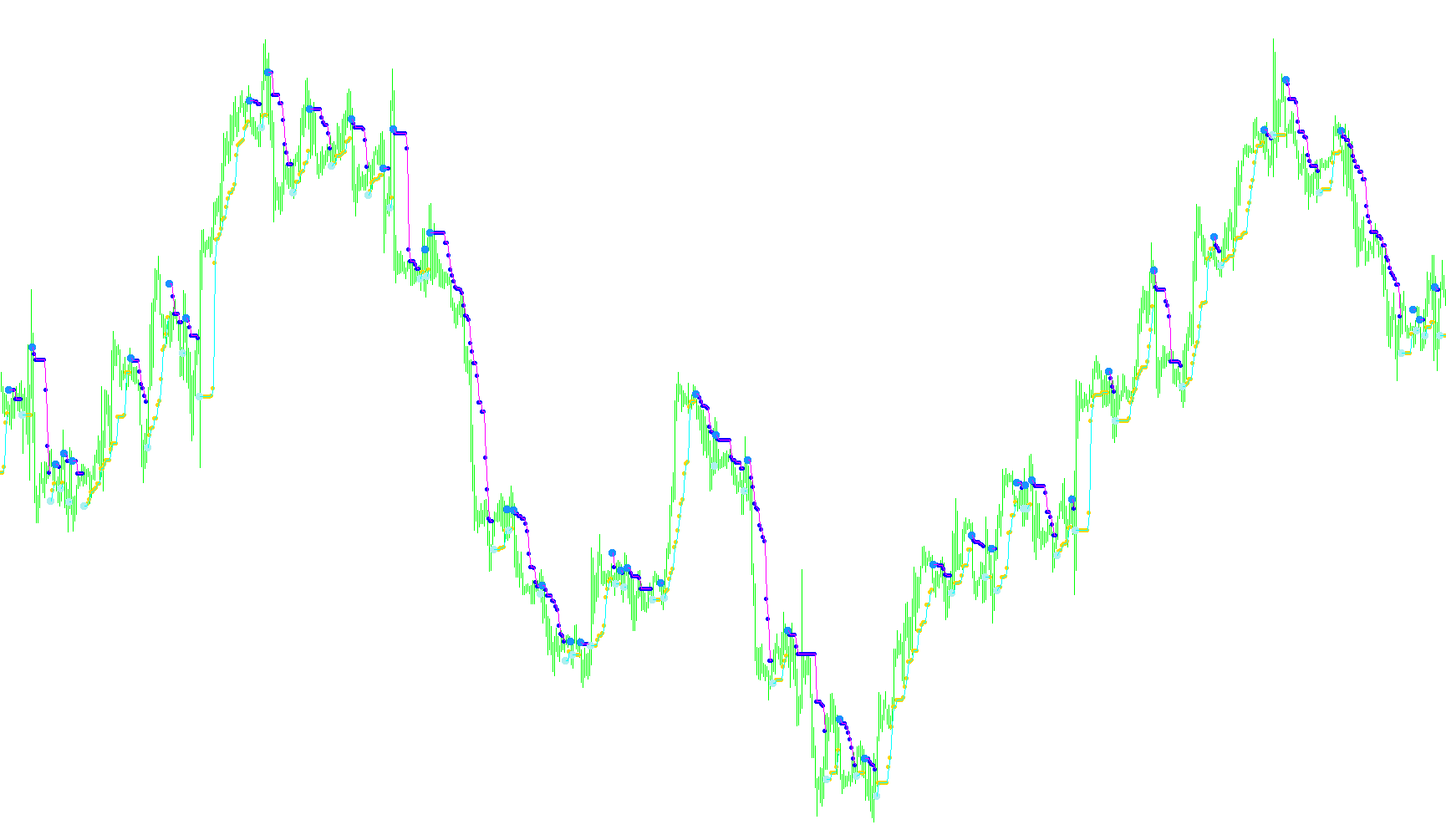
This script is designed to identify market trends and provide visual cues for potential trading entries by monitoring price action over a specific period. It works by calculating "price channels" and reacting when the market price breaks out of these established boundaries.
Core Logic and Functionality
Trend Identification The tool looks back at a set number of recent bars (defined by the Channel Period) to determine the highest high and lowest low reached during that time. Based on these extremes, it creates a "risk zone" or buffer area. The logic then determines the current market trend based on where the closing price sits in relation to these calculated boundaries.
Dynamic Boundaries The script doesn't just look at static highs and lows; it adjusts them dynamically. As the trend moves, the boundaries shift. If a price break occurs that confirms a new direction, the tool updates its internal tracking to reflect this new "floor" or "ceiling," allowing the indicator to follow the market's momentum.
Visual Signaling The script provides several visual layers on your chart:
- Trend Lines: These represent the active support or resistance levels based on the calculated risk parameters.
- Stop Levels: These act as the specific price points where a trend is confirmed or potentially reversed.
- Signal Indicators: The script places specific markers (arrows) on the chart to highlight unique moments of transition—specifically when the market switches from an upward bias to a downward one, or vice versa.
Alert System Beyond just visual aids, the script includes a monitoring system that watches for trend reversals in real-time. It specifically looks for instances where the trend status flips (e.g., switching from negative to positive) accompanied by trading volume. When these conditions are met, the script can trigger:
- On-Screen Alerts: Pop-up messages within the trading platform.
- Audio Notifications: Sound files to grab your attention immediately.
- Email Notifications: Sending a summary of the signal and the symbol/timeframe directly to your registered email.
Summary for the User
Essentially, this tool automates the process of identifying "breakout" points. Instead of manually trying to figure out if a price movement is a significant trend change or just noise, the script calculates the volatility of the recent past and draws lines on your chart to show you where the market is "breaking" out. It then highlights these transitions with arrows and alerts so you can react more quickly to shifts in market direction.
//+------------------------------------------------------------------+
//|                                       PriceChannel_Stop_v1.2.mq4 |
//|                                  Copyright © 2006, Forex-TSD.com |
//|                         Written by IgorAD,igorad2003@yahoo.co.uk |
//|            http://finance.groups.yahoo.com/group/TrendLaboratory |
//+------------------------------------------------------------------+
#property copyright "Copyright © 2006, Forex-TSD.com "
#property link      "http://www.forex-tsd.com/"

#property indicator_chart_window
#property indicator_buffers 6
#property indicator_color1 Aqua
#property indicator_color2 Magenta
#property indicator_color3 Aqua
#property indicator_color4 Magenta
#property indicator_color5 Aqua
#property indicator_color6 Magenta
//---- input parameters
extern int ChannelPeriod=9;
extern double Risk=0.30;
extern int Signal=1;
extern int Line=1;
extern int SoundAlertMode=0;
extern int SMSAlertMode=0;
extern int AlertTimes=1;
extern int Nbars=1000;
//---- indicator buffers
double UpTrendBuffer[];
double DownTrendBuffer[];
double UpTrendSignal[];
double DownTrendSignal[];
double UpTrendLine[];
double DownTrendLine[];
double trend[];
bool UpTrendAlert=false, DownTrendAlert=false;
//+------------------------------------------------------------------+
//| Custom indicator initialization function                         |
//+------------------------------------------------------------------+
int init()
  {
   string short_name;
//---- indicator line
   IndicatorBuffers(7);
   SetIndexBuffer(0,UpTrendBuffer);
   SetIndexBuffer(1,DownTrendBuffer);
   SetIndexBuffer(2,UpTrendSignal);
   SetIndexBuffer(3,DownTrendSignal);
   SetIndexBuffer(4,UpTrendLine);
   SetIndexBuffer(5,DownTrendLine);
   SetIndexBuffer(6,trend);
   SetIndexStyle(0,DRAW_ARROW);
   SetIndexStyle(1,DRAW_ARROW);
   SetIndexStyle(2,DRAW_ARROW);
   SetIndexStyle(3,DRAW_ARROW);
   SetIndexStyle(4,DRAW_LINE);
   SetIndexStyle(5,DRAW_LINE);
   SetIndexArrow(0,159);
   SetIndexArrow(1,159);
   SetIndexArrow(2,108);
   SetIndexArrow(3,108);
//---- name for DataWindow and indicator subwindow label
   short_name="PriceChannel_Stop_v1("+ChannelPeriod+")";
   IndicatorShortName(short_name);
   SetIndexLabel(0,"UpTrend Stop");
   SetIndexLabel(1,"DownTrend Stop");
   SetIndexLabel(2,"UpTrend Signal");
   SetIndexLabel(3,"DownTrend Signal");
   SetIndexLabel(4,"UpTrend Line");
   SetIndexLabel(5,"DownTrend Line");
//----
   SetIndexDrawBegin(0,ChannelPeriod);
   SetIndexDrawBegin(1,ChannelPeriod);
   SetIndexDrawBegin(2,ChannelPeriod);
   SetIndexDrawBegin(3,ChannelPeriod);
   SetIndexDrawBegin(4,ChannelPeriod);
   SetIndexDrawBegin(5,ChannelPeriod);
//----
   return(0);
  }
//+------------------------------------------------------------------+
//| PriceChannel_Stop_v1                                             |
//+------------------------------------------------------------------+
int start()
  {
   int    i,shift;
   double high, low, price;
   double smax[5000],smin[5000],bsmax[5000],bsmin[5000];
   string Message;

   for (shift=Nbars-1;shift>=0;shift--)
   {
   UpTrendBuffer[shift]=EMPTY_VALUE;
   DownTrendBuffer[shift]=EMPTY_VALUE;
   UpTrendSignal[shift]=-1;
   DownTrendSignal[shift]=-1;
   UpTrendLine[shift]=EMPTY_VALUE;
   DownTrendLine[shift]=EMPTY_VALUE;
   trend[shift]=0;
   }
   for (shift=Nbars-ChannelPeriod-1;shift>=0;shift--)
   {
      high=High[shift]; low=Low[shift]; i=shift-1+ChannelPeriod;
      while(i>=shift)
        {
         price=High[i];
         if(high<price) high=price;
         price=Low[i];
         if(low>price)  low=price;
         i--;
        }
     smax[shift]=high;
     smin[shift]=low;

     bsmax[shift]=smax[shift]-(smax[shift]-smin[shift])*Risk;
	  bsmin[shift]=smin[shift]+(smax[shift]-smin[shift])*Risk;

     trend[shift]=trend[shift+1];
     if (Close[shift]>bsmax[shift+1])  {trend[shift]= 1; }
	  if (Close[shift]<bsmin[shift+1])  {trend[shift]=-1; }

	  if(trend[shift]>0 && bsmin[shift]<bsmin[shift+1]) bsmin[shift]=bsmin[shift+1];
	  if(trend[shift]<0 && bsmax[shift]>bsmax[shift+1]) bsmax[shift]=bsmax[shift+1];

	  if (trend[shift]>0)
	  {

	     if (Signal>0 && UpTrendBuffer[shift+1]==-1.0)
	     {
	     UpTrendSignal[shift]=bsmin[shift];
	     if(Line>0) UpTrendLine[shift]=bsmin[shift];
	     if (SoundAlertMode>0 && shift==0) PlaySound("alert2.wav");
	     }
	     else
	     {
	     UpTrendBuffer[shift]=bsmin[shift];
	     if(Line>0) UpTrendLine[shift]=bsmin[shift];
	     UpTrendSignal[shift]=-1;
	     }

	  if (Signal==2) UpTrendBuffer[shift]=0;
	  DownTrendBuffer[shift]=-1.0;
	  DownTrendLine[shift]=EMPTY_VALUE;
	  }


	  if (trend[shift]<0)
	  {

	  if (Signal>0 && DownTrendBuffer[shift+1]==-1.0)
	     {
	     DownTrendSignal[shift]=bsmax[shift];
	     if(Line>0) DownTrendLine[shift]=bsmax[shift];
	     if (SoundAlertMode>0 && shift==0) PlaySound("alert2.wav");
	     }
	     else
	     {
	     DownTrendBuffer[shift]=bsmax[shift];
	     if(Line>0)DownTrendLine[shift]=bsmax[shift];
	     DownTrendSignal[shift]=-1;
	     }

	  if (Signal==2) DownTrendBuffer[shift]=0;
	  UpTrendBuffer[shift]=-1.0;
	  UpTrendLine[shift]=EMPTY_VALUE;
	  }


	  //if ( trend[0]>0 && Close[2]<=bsmax[3] && Close[1]>bsmax[2] && Volume[0]>1 && !UpTrendAlert)
	  if ( trend[2]<0 && trend[1]>0 && Volume[0]>1 && !UpTrendAlert)
	  {
	  Message = " "+Symbol()+" M"+Period()+": Signal for BUY";
	  if ( SoundAlertMode>0 ) Alert (Message);
	  if ( SMSAlertMode>0   ) SendMail ("Signal from PriceChannel_Stop",TimeToStr(CurTime())+Message);
	  UpTrendAlert=true; DownTrendAlert=false;
	  }


	  //if ( trend[0]<0 && Close[2]>=bsmin[3] && Close[1]<bsmin[2] && Volume[0]>1 && !DownTrendAlert)
	  if ( trend[2]>0 && trend[1]<0 && Volume[0]>1 && !DownTrendAlert)
	  {
	  Message = " "+Symbol()+" M"+Period()+": Signal for SELL";
	  if ( SoundAlertMode>0 ) Alert (Message);
	  if ( SMSAlertMode>0   ) SendMail ("Signal from PriceChannel_Stop",TimeToStr(CurTime())+Message);
	  DownTrendAlert=true; UpTrendAlert=false;
	  }

   }
   return(0);
  }
//+------------------------------------------------------------------+
Comments