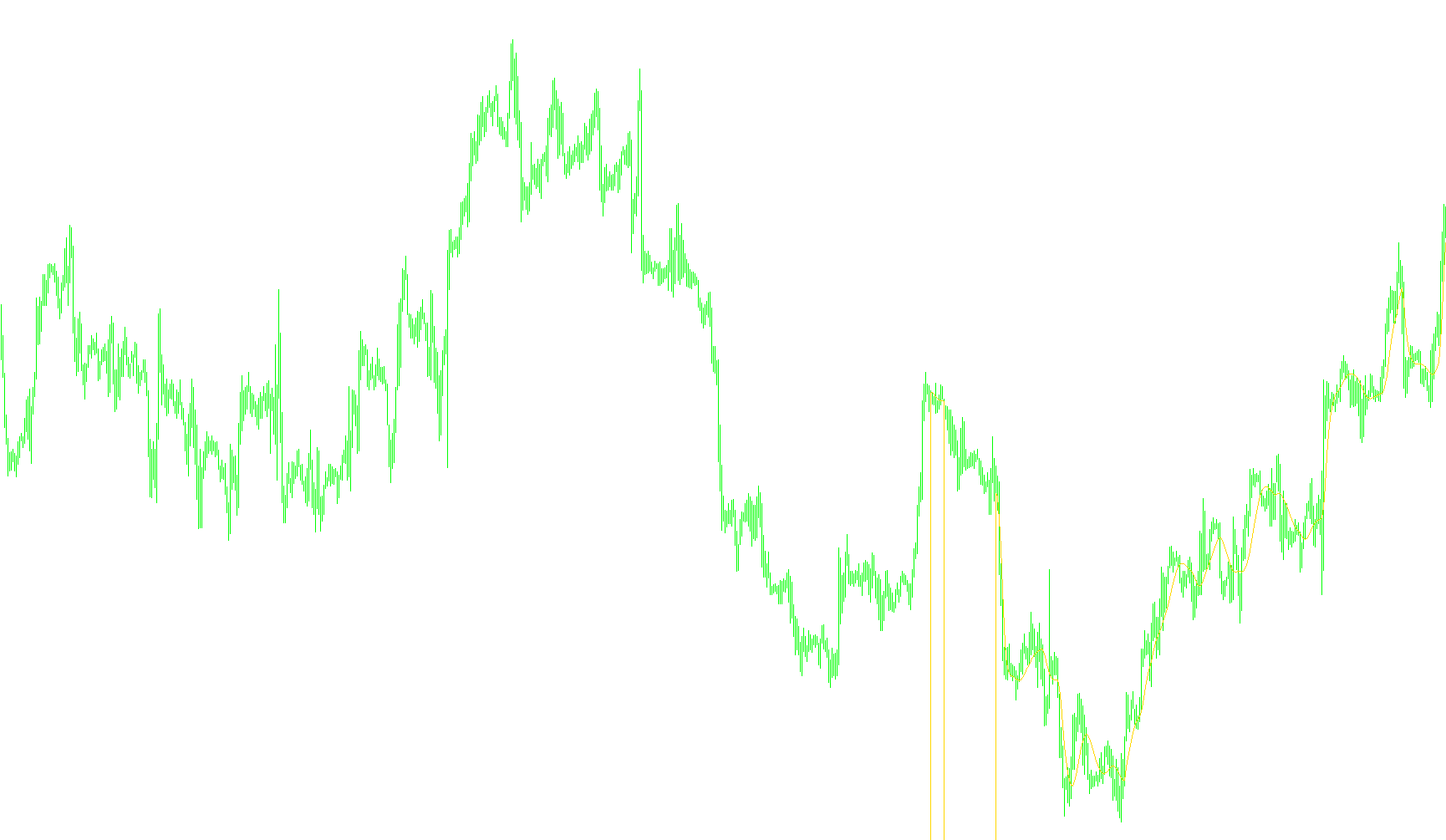
This script functions as a specialized technical analysis tool designed to smooth out price fluctuations in financial markets. Its primary purpose is to provide a "cleaned" view of price action, helping traders identify the underlying trend by reducing market noise without introducing the significant time lags often associated with standard moving averages.
Core Logic and Behavior
1. Adaptive Data Processing Unlike basic indicators that treat every data point with equal importance, this script uses a complex, multi-layered mathematical approach to handle incoming price data. It looks back at a specific set of historical candles (defined by the user) to build an internal model of the market's behavior.
2. Dynamic Smoothing and Sensitivity The tool incorporates several "rings" or buffers of memory to track recent price movements. It calculates the velocity and direction of the price change, then applies a series of transformations to determine how much weight to give to the current price versus historical data. This allows the indicator to react quickly to significant market shifts while remaining stable during periods of minor volatility.
3. Sophisticated Trend Mapping The logic utilizes non-linear calculations—including logarithmic and square root operations—to "shape" the resulting line. By doing this, the script attempts to mimic the organic flow of the market. It essentially performs a sophisticated interpolation, where it seeks to find the most logical path between price points, filtering out "erratic" spikes that do not align with the broader trend.
4. Parameter Influence The tool allows for user customization through three primary levers:
- Length: Determines the overall window of observation; a higher number smooths the data more aggressively.
- Phase: Adjusts the "responsiveness" or the aggressive nature of the smoothing logic.
- Bar Count: Defines the amount of historical data the script analyzes to establish its baseline.
User Experience Summary
For a trader, this script translates into a smooth, flowing line on the chart that follows price closely but ignores "jitter." It is designed for those who need to see where the market is actually heading, providing a more refined perspective than standard tools by balancing the trade-off between speed (reacting to news) and smoothness (avoiding false signals).
//+------------------------------------------------------------------+
//| JMA.mq4 |
//| Spiggy |
//| |
//+------------------------------------------------------------------+
#property copyright "Spiggy"
#property link ""
//----
#property indicator_chart_window
#property indicator_buffers 1
#property indicator_color1 Red
//---- input parameters
extern int Len=14;
extern int phase=0;
extern int BarCount=300;
//---- buffers
double ExtMapBuffer1[];
//+------------------------------------------------------------------+
//| Custom indicator initialization function |
//+------------------------------------------------------------------+
int init()
{
//---- indicators
SetIndexStyle(0,DRAW_LINE);
SetIndexBuffer(0,ExtMapBuffer1);
//----
return(0);
}
//+------------------------------------------------------------------+
//| Custor indicator deinitialization function |
//+------------------------------------------------------------------+
int deinit()
{
//----
//----
return(0);
}
//+------------------------------------------------------------------+
//| Custom indicator iteration function |
//+------------------------------------------------------------------+
int start()
{
int counted_bars=IndicatorCounted();
//----
// variable definitions
bool firstTime=True;
int AccountedBars=0;
int jj=0;
int ii=0;
int shift=0;
double series=0;
//----
double vv=0;
double v1=0;
double v2=0;
double v3=0;
double v4=0;
double s8=0;
double s10=0;
double s18=0;
double s20=0;
int v5=0;
int v6=0;
double s28=0;
double s30=0;
int s38=0;
int s40=0;
int s48=0;
int s50=0;
int s58=0;
int s60=0;
double s68=0;
double s70=0;
double f8=0;
double f10=0;
double f18=0;
double f20=0;
double f28=0;
double f30=0;
double f38=0;
double f40=0;
double f48=0;
double f50=0;
double f58=0;
double f60=0;
double f68=0;
double f70=0;
double f78=0;
double f80=0;
double f88=0;
double f90=0;
double f98=0;
double fA0=0;
double fA8=0;
double fB0=0;
double fB8=0;
double fC0=0;
double fC8=0;
double fD0=0;
double f0=0;
double fD8=0;
double fE0=0;
double fE8=0;
int fF0=0;
double fF8=0;
int value2=0;
double JMA=0;
double prevtime=0;
//----
double list[127];
double ring1[127];
double ring2[10];
double buffer[61];
//----
ArrayInitialize(list,0);
ArrayInitialize(ring1,0);
ArrayInitialize(ring2,0);
ArrayInitialize(buffer,0);
//----
if (firstTime)
{
AccountedBars=Bars-BarCount;
firstTime=False;
}
if ((CurTime()-prevtime)<30)
return(-1);
//----
prevtime=CurTime();
//SetLoopCount(0);
{
s28=63;
s30=64;
for( ii=1;ii<=s28;ii++)
{
list[ii]=-1000000;
}
for( ii=s30;ii<=127 ;ii++ )
{
list[ii]=1000000;
}
f0=1;
}
//----
for( shift=BarCount;shift>=0;shift-- )
{
series=Close[shift];
if (fF0 < 61)
{
fF0= fF0 + 1;
buffer[fF0]=series;
} //{ main cycle }
if (fF0 > 30)
{
if (Len < 1.0000000002)
{
f80=0.0000000001; //{1.0e-10}
}
else
{
f80=(Len - 1)/2.0;
}
if (phase < -100)
{
f10=0.5;
}
else
{
if (phase > 100)
{
f10=2.5;
}
else
{
f10=phase/100 + 1.5;
}
}
v1=MathLog(MathSqrt(f80));
v2=v1;
if (v1/MathLog(2.0) + 2.0 < 0.0)
{
v3=0;
}
else
{
v3=v2/MathLog(2.0) + 2.0;
}
f98=v3;
//----
if (0.5<=f98 - 2.0)
{
f88=f98 - 2.0;
}
else
{
f88=0.5;
}
f78=MathSqrt(f80) * f98;
f90=f78/(f78 + 1.0);
f80=f80 * 0.9;
f50=f80/(f80 + 2.0);
//----
if (f0!=0)
{
f0=0;
v5=0;
for( ii=1;ii <=29;ii++)
{
if (buffer[ii+1]!=buffer[ii])
{
v5=1.0;
}
}
fD8=v5*30.0;
if (fD8==0)
{
f38=series;
}
else
{
f38=buffer[1];
}
f18=f38;
if (fD8 > 29)
fD8=29;
}
else
fD8=0;
//----
for( ii=fD8;ii>=0;ii-- )
{ //{ another bigcycle...}
value2=31-ii;
if (ii==0)
{
f8=series;
}
else
{
f8=buffer[value2];
}
f28=f8 - f18;
f48=f8 - f38;
if (MathAbs(f28) > MathAbs(f48))
{
v2=MathAbs(f28);
}
else
{
v2=MathAbs(f48);
}
fA0=v2;
vv=fA0 + 0.0000000001; //{1.0e-10;}
//----
if (s48<=1)
{
s48=127;
}
else
{
s48=s48 - 1;
}
if (s50<=1)
{
s50=10;
}
else
{
s50=s50 - 1;
}
if (s70 < 128)
s70=s70 + 1;
s8=s8 + vv - ring2[s50];
ring2[s50]=vv;
if (s70 > 10)
{
s20=s8/10;
}
else
s20=s8/s70;
//----
if (s70 > 127)
{
s10=ring1[s48];
ring1[s48]=s20;
s68=64;
s58=s68;
while(s68 > 1)
{
if (list[s58] < s10)
{
s68=s68 *0.5;
s58=s58 + s68;
}
else
if (list[s58]<=s10)
{
s68=1;
}
else
{
s68=s68 *0.5;
s58=s58 - s68;
}
}
}
else
{
ring1[s48]=s20;
if (s28 + s30 > 127)
{
s30=s30 - 1;
s58=s30;
}
else
{
s28=s28 + 1;
s58=s28;
}
if (s28 > 96)
{
s38=96;
}
else
s38=s28;
if (s30 < 32)
{
s40=32;
}
else
s40=s30;
}
//----
s68=64;
s60=s68;
while(s68 > 1)
{
if (list[s60]>=s20)
{
if (list[s60 - 1]<=s20)
{
s68=1;
}
else
{
s68=s68 *0.5;
s60=s60 - s68;
}
}
else
{
s68=s68 *0.5;
s60=s60 + s68;
}
if ((s60==127) && (s20 > list[127]))
s60=128;
}
if (s70 > 127)
{
if (s58>=s60)
{
if ((s38 + 1 > s60) && (s40 - 1 < s60))
{
s18=s18 + s20;
}
else
if ((s40 > s60) && (s40 - 1 < s58))
s18=s18 + list[s40 - 1];
}
else
if (s40>=s60)
{
if ((s38 + 1 < s60) && (s38 + 1 > s58))
s18=s18 + list[s38 + 1];
}
else
if (s38 + 2 > s60)
{
s18=s18 + s20;
}
else
if ((s38 + 1 < s60) && (s38 + 1 > s58))
s18=s18 + list[s38 + 1];
if (s58 > s60)
{
if ((s40 - 1 < s58) && (s38 + 1 > s58))
{
s18=s18 - list[s58];
}
else
if ((s38 < s58) && (s38 + 1 > s60))
s18=s18 - list[s38];
}
else
{
if ((s38 + 1 > s58) && (s40 - 1 < s58))
{
s18=s18 - list[s58];
}
else
if ((s40 > s58) && (s40 < s60))
s18=s18 - list[s40];
}
}
if (s58<=s60)
{
if (s58>=s60)
{
list[s60]=s20;
}
else
{
for( jj=s58 + 1;jj<=s60 - 1;jj++)
{
list[jj - 1]=list[jj];
}
list[s60 - 1]=s20;
}
}
else
{
for( jj=s58 - 1;jj>=s60;jj-- )
{
list[jj + 1]=list[jj];
}
list[s60]=s20;
}
if (s70<=127)
{
s18=0;
for(jj=s40;jj<=s38;jj++)
{
s18=s18 + list[jj];
}
}
f60=s18/(s38 - s40 + 1);
if (fF8 + 1 > 31)
{
fF8=31;
}
else
fF8=fF8 + 1;
//----
if (fF8<=30)
{
if (f28 > 0)
{
f18=f8;
}
else
f18=f8 - f28 * f90;
if (f48 < 0)
{
f38=f8;
}
else
f38=f8 - f48 * f90;
fB8=series;
//{EasyLanguage does not have "continue" statement}
if (fF8!=30)
{
continue;
}
if (fF8==30)
{
fC0=series;
if (MathCeil(f78)>=1)
{
v4=MathCeil(f78);
}
else
v4=1;
fE8=MathCeil(v4);
if (MathFloor(f78)>=1)
{
v2=MathFloor(f78);
}
else
v2=1;
fE0=MathCeil(v2);
if (fE8==fE0)
{
f68=1;
}
else
{
v4=fE8 - fE0;
f68=(f78 - fE0)/v4;
}
if (fE0<=29)
{
v5=fE0;
}
else
v5=29;
if (fE8<=29)
{
v6=fE8;
}
else
v6=29;
fA8=(series - buffer[fF0 - v5]) * (1 - f68)/fE0 + (series - buffer[fF0 - v6]) * f68/fE8;
}
}
else
{
if (f98>=MathPow(fA0/f60, f88))
{
v1=MathPow(fA0/f60, f88);
}
else
v1=f98;
if (v1 < 1)
{
v2=1;
}
else
{
if (f98>=MathPow(fA0/f60, f88))
{
v3=MathPow(fA0/f60, f88);
}
else
v3=f98;
v2=v3;
}
f58=v2;
f70=MathPow(f90, MathSqrt(f58));
if (f28 > 0)
{
f18=f8;
}
else
{
f18=f8 - f28 * f70;
}
if (f48 < 0)
{
f38=f8;
}
else
{
f38=f8 - f48 * f70;
}
}
}
if (fF8 > 30)
{
f30=MathPow(f50, f58);
fC0=(1 - f30) * series + f30 * fC0;
fC8=(series - fC0) * (1 - f50) + f50 * fC8;
fD0=f10 * fC8 + fC0;
f20=-f30 * 2;
f40=f30 * f30;
fB0=f20 + f40 + 1;
fA8=(fD0 - fB8) * fB0 + f40 * fA8;
fB8=fB8 + fA8;
}
JMA= fB8;
}
if (fF0<=30)
{
JMA=0;
}
//Print ("JMA is " + JMA + " shift is " + shift);
ExtMapBuffer1[shift]=JMA;
//----
if (shift>0)
{
AccountedBars=AccountedBars+1;
}
}
//----
return(0);
}
//+------------------------------------------------------------------+
Comments